Commentary
No English page

No English page
The American and Japanese printings side by side. Click either page to zoom in.
Why Not Try the Treasure Hunt Yourself? by Masaki Yoshihiro (Translator)
The Japanese text with an English back-translation.
Japanese text
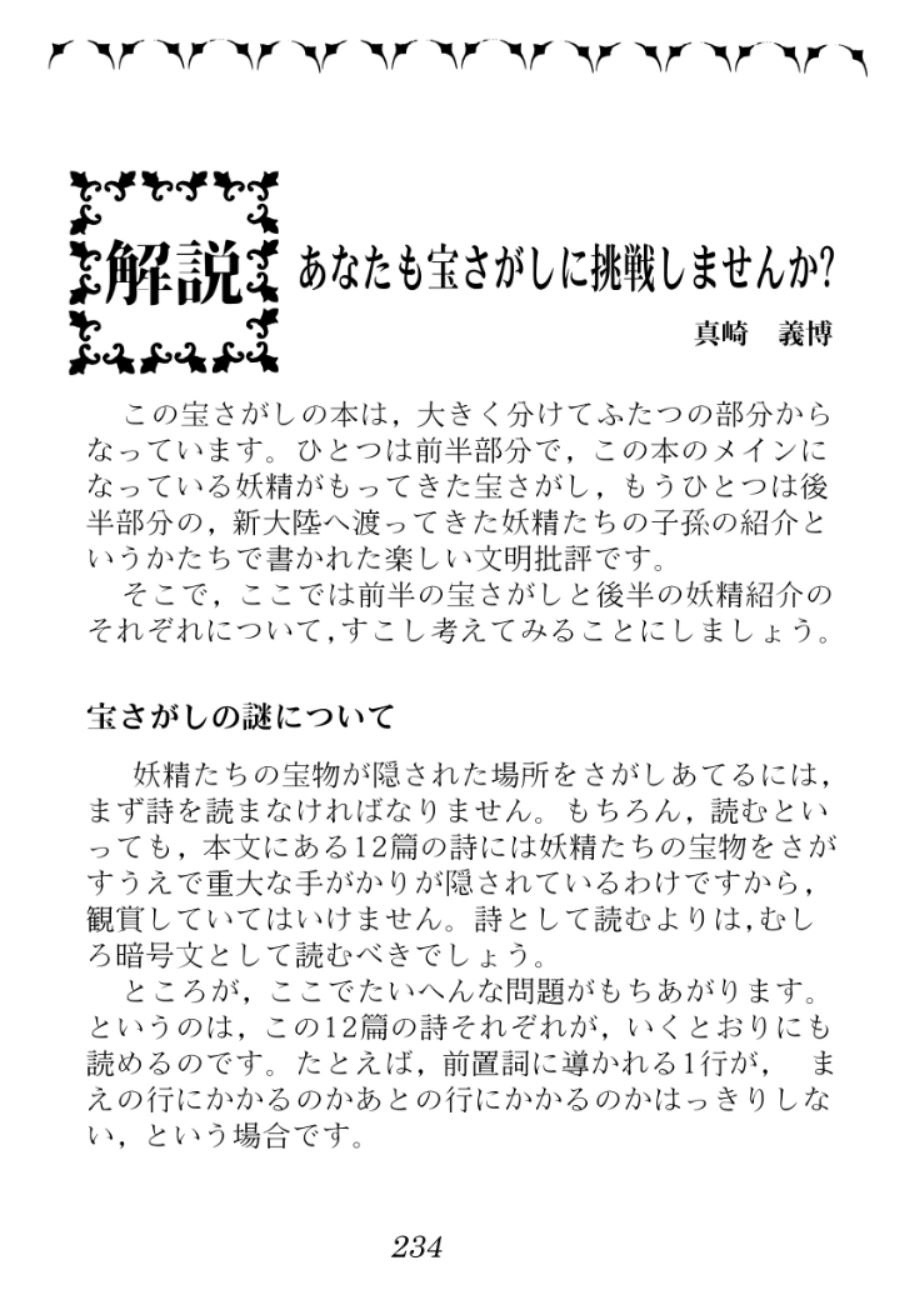
解説 あなたも宝さがしに挑戦しませんか?真崎 義博この宝さがしの本は、大きく分けてふたつの部分からなっています。 ひとつは前半部分で,この本のメインになっている妖精がもってきた宝さがし,もうひとつは後半部分の, 新大陸へ渡ってきた妖精たちの子孫の紹介というかたちで書かれた楽しい文明批評です。そこで,ここでは前半の宝さがしと後半の妖精紹介のそれぞれについて, すこし考えてみることにしましょう。宝さがしの謎について妖精たちの宝物が隠された場所をさがしあてるには,まず詩を読まなければなりません。 もちろん, 読むといっても,本文にある12篇の詩には妖精たちの宝物をさがすうえで重大な手がかりが隠されているわけですから、観賞していてはいけません。 詩として読むよりは,むしろ暗号文として読むべきでしょう。ところが,ここでたいへんな問題がもちあがります。というのは、この12篇の詩それぞれが,いくとおりにも読めるのです。 たとえば, 前置詞に導かれる1行が, まえの行にかかるのかあとの行にかかるのかはっきりしない, という場合です。
English back-translation
Commentary — Why Not Try the Treasure Hunt Yourself? by Masaki Yoshihiro (Translator)
This treasure hunt book is broadly divided into two parts. The first is the main section — the treasure hunt involving the jewels brought by the fairies. The second is the latter section — an enjoyable work of cultural criticism written in the form of an introduction to the descendants of the fairies who crossed to the New World.
So here, let us think a little about each of these two aspects — the treasure hunt of the first half, and the fairy introductions of the second half.
On the Mystery of the Treasure Hunt
To find the locations where the fairies’ treasures are hidden, you must first read the verses. Of course, when I say “read” — since each of the twelve verses in the main text contains crucial clues for finding the fairies’ treasures, you must not simply appreciate them as poetry. Rather than reading them as poems, you should read them as coded messages.
However, a tremendously difficult problem arises here. Each of these twelve verses can be read in any number of ways. For instance, there are cases where it is unclear whether a line introduced by a preposition modifies the line before it or the line after it.
234